Quick answer
To lower humidity in your house fast, run bathroom and kitchen exhaust fans that vent outside, use your air conditioner or a dehumidifier in the dampest room with its doors and windows closed, dry laundry outdoors or in a vented dryer, and turn off any humidifier. To lower it for good, find the source: fix leaks and seepage, vent moisture-producing appliances outdoors, cover bare dirt in a crawlspace and warm up cold surfaces. The EPA recommends keeping indoor humidity below 60%, ideally between 30% and 50%; the CDC says no higher than 50%.
First, measure: how humid is too humid?
Before you change anything, get a number. An inexpensive digital hygrometer shows relative humidity (RH), the amount of water vapor in the air compared with the most it could hold at that temperature. Put it in the room that worries you, away from the shower, stove and windows, and check it at different times of day for a week.
The EPA advises keeping indoor relative humidity below 60%, and ideally between 30% and 50%. The CDC’s advice for preventing mold is stricter: keep humidity “as low as you can — no higher than 50% — all day long.” Short spikes after a shower or while cooking are normal; what matters is a level that stays high for hours or days. Our guide to the ideal indoor humidity level explains how to read the numbers.
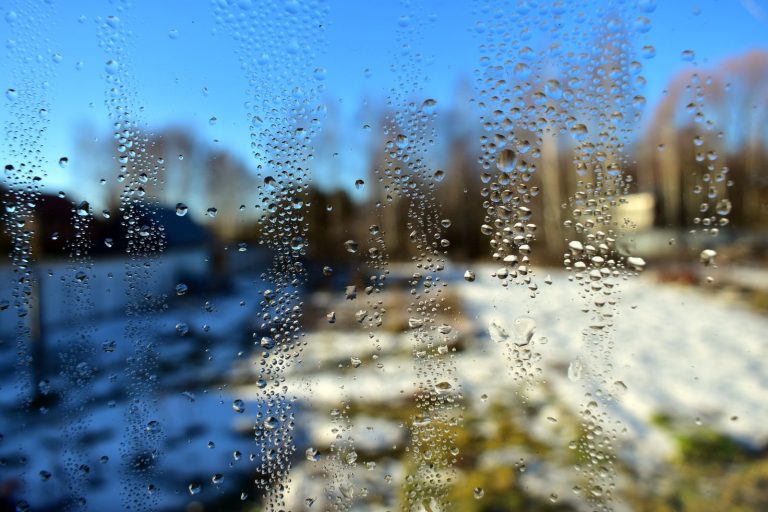
Your house also gives you signs. The EPA notes that condensation on windows, walls or pipes “can be a sign of high humidity.” Musty odors, mold spots in corners and closets, and peeling paint in bathrooms point the same way.
Fast fixes you can do today
These steps bring humidity down within hours or days. They don’t fix a leak or a wet basement, but they stop the problem getting worse while you look for the cause.
- Run the exhaust fans. The EPA says to run the bathroom fan or open a window when showering, and to use exhaust fans or open windows when cooking, running the dishwasher or washing dishes. Leave the bathroom fan on after the shower, too; see how long to run a bathroom exhaust fan.
- Turn on the air conditioner in humid weather. Both the EPA and the CDC list air conditioners alongside dehumidifiers as tools to keep humidity down.
- Run a dehumidifier in the dampest room. ENERGY STAR advises keeping the doors and windows of that space closed while it runs and leaving room for air to circulate around the unit. Set its humidistat within the 30–50% range.
- Turn off humidifiers. If you see condensation on windows or other surfaces, the EPA says to turn off appliances such as humidifiers or kerosene heaters.
- Move laundry out of the living space. Dry clothes outdoors, or in a dryer vented outside. A drying rack indoors releases all the water in the load into the house; see drying clothes indoors.
- Dry anything wet quickly. The EPA says that if wet or damp materials are dried within 24–48 hours after a leak or spill, in most cases mold will not grow.
Find where the moisture comes from
Lasting results come from removing moisture at the source. The EPA lists cooking and showering, humidifiers, steam radiators, moisture-generating appliances such as dryers, and combustion appliances such as stoves among the things that raise indoor humidity. University of Minnesota Extension groups basement moisture into three sources: liquid water from rain or groundwater, interior sources such as unvented dryers, bathrooms and cooking, and humid outdoor air that condenses on cooler surfaces. Use the table to match what you see with a likely cause.
| Source | Where it shows up | What fixes it |
|---|---|---|
| Showers and baths | Bathroom ceiling, grout, mirror stays fogged | Exhaust fan vented outdoors, run during and after |
| Cooking and dishwashing | Kitchen windows, greasy film on cabinets | Range hood vented outdoors, lids on pots |
| Laundry dried indoors or a dryer venting inside | Windows and walls of the drying room | Dry outdoors; vent the dryer outside |
| Humidifier set too high | Condensation on windows in winter | Turn it down or off |
| Leaks (roof, plumbing, windows) | Stains, damp patches in one spot | Repair the leak, dry the materials |
| Rain or groundwater | Basement walls and floor, crawlspace | Gutters, grading, waterproofing; plastic over crawlspace dirt |
| Humid outdoor air in summer | Cool basement walls, cold water pipes | Keep windows closed in humid weather; AC or dehumidifier |
If you suspect the basement, start with our guide to a damp basement: telling condensation from seepage decides which fix works.
Fixes that last
Long-term humidity checklist
- Fix leaks and seepage. The EPA’s first moisture-control step: repair roof, wall and plumbing leaks, and keep water away from the foundation with landscaping or waterproofing.
- Vent appliances outdoors. Clothes dryers, stoves and kerosene heaters should vent to the outside where possible. Check that the dryer duct is connected and the outdoor flap opens.
- Make sure exhaust fans really exhaust. Bathroom and kitchen fans should send air outdoors, not into the attic or a wall cavity.
- Cover crawlspace dirt. The EPA recommends a plastic cover over dirt in crawlspaces and making sure the crawlspace is well ventilated.
- Warm up cold surfaces. Insulation, storm windows and better air circulation raise the temperature of cold surfaces, and the EPA suggests insulating cold water pipes so they stop sweating.
- Watch carpet on concrete. The EPA suggests removable area rugs on concrete floors, or a vapor barrier under carpet.
- Keep the dehumidifier for what’s left. Once the sources are dealt with, a dehumidifier handles the remaining moisture with less effort.
The EPA also points out that the right moisture solution depends on your climate and how your house is built. A house in the humid Southeast and one in a cold northern state can have the same reading on the hygrometer for very different reasons.
Summer and winter need different tactics
In humid summer weather, the outdoor air is often the moisture source. University of Minnesota Extension explains that warm, humid outdoor air condenses on cool basement walls and floors, and that many homeowners mistake this for a leak. Opening windows on a muggy day can raise indoor humidity instead of lowering it. Keep the house closed and let the air conditioner and, where needed, a dehumidifier do the work.
In cold weather, outdoor air holds little water, so bringing some of it in, through exhaust fans or a window opened briefly, usually lowers indoor humidity. The problem in winter is cold surfaces: windows, exterior corners and closets on outside walls. Our article on whether opening windows reduces humidity explains how to tell which situation you’re in.
Worked example
Assumed values: a bedroom at 68°F (20°C) with an exterior corner that reaches 50°F (10°C) on a cold night. Condensation forms on any surface colder than the air’s dew point.
- At 60% RH, the dew point is about 54°F (12°C). The 50°F corner is colder, so it gets wet.
- At 45% RH, the dew point is about 46°F (8°C). The same corner stays above it and stays dry.
- Lowering humidity by 15 points made the difference, without changing the wall.
Illustrative example with assumed temperatures; dew points calculated with the Magnus formula and rounded. Try your own numbers in our dew point calculator.
When a dehumidifier makes sense
A dehumidifier is the right tool when humidity stays high after you have dealt with the sources, typically in basements, crawlspace-adjacent rooms and humid climates. ENERGY STAR sizes them by how damp the space is and how big it is:
| Condition of the space | Up to 2,000 sq ft | Over 2,000 sq ft |
|---|---|---|
| Slightly to moderately damp | 20–30 pints/day | 30+ pints/day |
| Very damp | 25–40 pints/day | 40+ pints/day |
| Wet | 30–50 pints/day | 50+ pints/day |
ENERGY STAR says certified models use 20% less energy than similar conventional units and all include a built-in humidistat. For the details, see what size dehumidifier you need and where to place it.
Watch out: a dehumidifier treats the symptom, not the cause. University of Minnesota Extension notes that in a basement it “is not a permanent or complete solution,” and that drying the air can draw moisture through the concrete faster if water is getting in from outside. Fix the water first.
When to get help
Call a contractor or building professional if humidity stays high despite the steps above, if you find water stains you can’t explain, if water comes through basement walls after rain, or if mold keeps returning or covers a large area. For small areas, see how to clean mold safely.
Health: the CDC says exposure to damp and moldy environments “may cause a variety of health effects, or none at all,” and that people with asthma or mold allergies may react more strongly. If you have symptoms you think are related to your home, talk to your doctor. More in is household mold dangerous?
Frequently asked questions
What is the fastest way to lower humidity in a room?
Close the room, run a dehumidifier or the air conditioner, and remove the source: stop drying laundry there, run the exhaust fan, turn off any humidifier. In cool, dry weather, a short burst of outdoor air also helps.
Can I lower humidity without a dehumidifier?
Often, yes. Exhaust fans, a vented dryer, fixing leaks and, in summer, the air conditioner remove a lot of moisture. A dehumidifier is for what remains, especially in basements.
Do bowls of salt, rice or baking soda lower humidity?
Not in any meaningful way for a whole room. Passive absorbers can help in a small closed space such as a closet, but the moisture from showers, cooking and laundry is far more than they can take up. Ventilation and source control are what move the hygrometer.
Is 60% humidity too high?
As a constant level, yes: the EPA’s advice is to stay below 60%, ideally 30–50%, and the CDC says no higher than 50%. A brief rise after a shower is not a problem if it comes back down.
Sources
- U.S. EPA. A Brief Guide to Mold, Moisture and Your Home: humidity targets, exhaust fans, venting appliances, drying within 24–48 hours.
- U.S. EPA. What are the main ways to control moisture in your home?: leaks, crawlspaces, cold surfaces, carpets on concrete.
- U.S. EPA. Mold Course, Chapter 2: sources of indoor humidity and condensation.
- CDC. About Mold and Your Health: humidity no higher than 50%, health effects.
- ENERGY STAR. Dehumidifiers: sizing chart, efficiency, use tips.
- University of Minnesota Extension. Moisture in basements: causes and solutions: moisture sources, summer condensation, limits of dehumidifiers.
Next step