Quick answer
According to the EPA, if the moldy area is less than about 10 square feet (roughly a 3 ft by 3 ft patch), in most cases you can clean it yourself. Fix the water problem first, protect yourself with gloves, goggles without vent holes and an N-95 respirator, scrub hard surfaces with detergent and water, and dry them completely. Porous materials such as ceiling tiles or carpet may have to be thrown away. Bleach is not needed as a routine step; if you do use it, the CDC says no more than 1 cup of household laundry bleach per gallon of water, never mixed with ammonia or other cleaners.
This guide is not medical advice. The EPA says that if you have health concerns, you should consult a health professional before starting cleanup. If you have asthma, allergies, lung disease or a weakened immune system, ask your doctor first or have someone else do the job.
Is it small enough to do yourself?
The EPA’s Brief Guide to Mold, Moisture and Your Home says who should do the cleanup depends on several factors, and one of them is size. Under about 10 square feet, most people can handle it themselves by following the guidelines. Call in outside help when:
- The area is larger than 10 square feet or there has been a lot of water damage. The EPA points to its guide on mold remediation in schools and commercial buildings, which also applies to homes.
- The water was sewage or otherwise contaminated. The EPA recommends a professional with experience cleaning buildings damaged by contaminated water.
- The heating or cooling system may be moldy. The EPA says not to run the HVAC system if you know or suspect it is contaminated, because it could spread mold through the building.
- You suspect hidden mold, for example behind wallpaper or inside a wall. Peeling off wallpaper can release a large number of spores, so the EPA suggests considering an experienced professional.
If you rent, the EPA advises reporting plumbing leaks and moisture problems to the building owner or manager right away. That comes before any scrubbing, because the cause is usually something only the owner can repair.
What to wear
The goal is to avoid breathing spores and to keep mold off your skin and out of your eyes. The EPA lists three items:
| Item | What the EPA recommends |
|---|---|
| Respirator | An N-95 respirator to limit exposure to airborne mold. It only works if it fits well. |
| Gloves | Long gloves reaching the middle of the forearm. Ordinary household rubber gloves are fine with water and mild detergent. With bleach, a disinfectant or a strong cleaner, use natural rubber, neoprene, nitrile, polyurethane or PVC. |
| Eye protection | Goggles without ventilation holes. |
The EPA adds a simple rule: avoid touching mold or moldy items with your bare hands, and avoid getting mold or spores in your eyes.
Step by step
- Stop the water. The EPA calls moisture control the key to mold control: fix leaks and other water problems as soon as possible. Without that, the mold comes back.
- Open a window and put on your gear. The CDC advises opening windows and doors to provide fresh air.
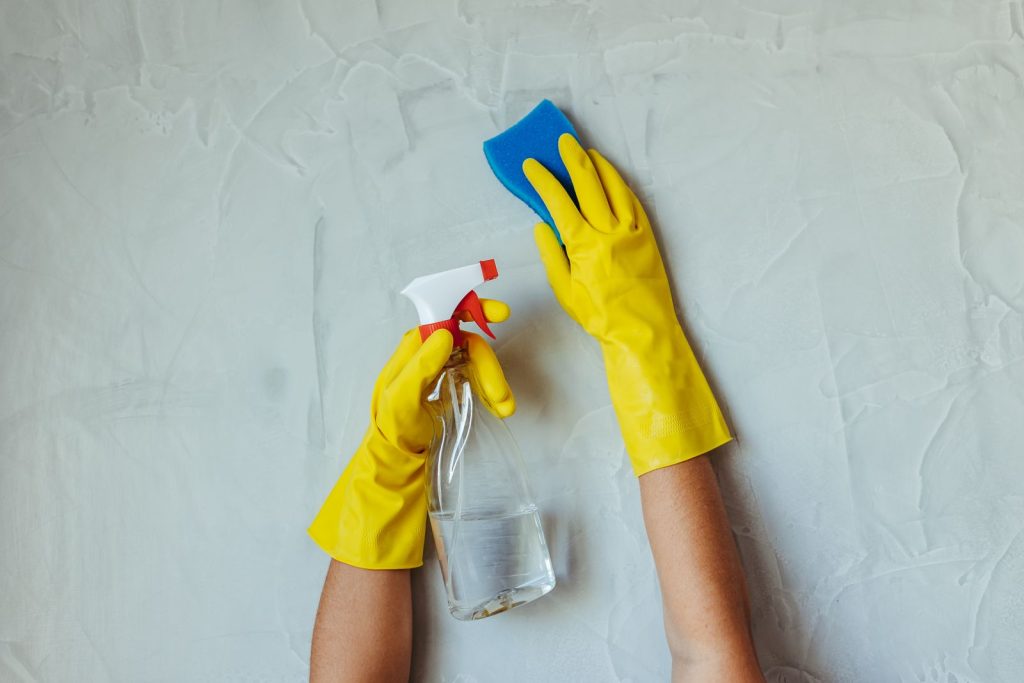
- Scrub hard surfaces with detergent and water. Tile, glass, sealed countertops and painted metal usually clean up well.
- Dry everything completely. The EPA stresses drying cleaned surfaces fully. A fan or a dehumidifier helps in a room that stays damp.
- Deal with porous materials. Ceiling tiles, carpet, drywall paper and similar materials may have to be thrown away, because mold grows into the gaps where you cannot reach it.
- Avoid spreading it. The EPA advises avoiding exposing yourself or others to mold while you work; if an item is expensive or of sentimental value, it suggests consulting a specialist in restoration.
The EPA also warns not to paint or caulk over moldy surfaces. Clean and dry first; paint applied over mold is likely to peel. Mold can leave stains, and the EPA notes that it may not be possible to restore the original look of an item.
Bleach: only if needed, and never mixed
Many people reach for bleach first, but the EPA says using a biocide such as chlorine bleach is not recommended as a routine practice during mold cleanup. In most cases it is not possible or desirable to sterilize an area: some spores will always be present, and they will not grow once the moisture problem is solved. There may be exceptions where professional judgment calls for it, for example when people with weakened immune systems are present.
If you do decide to use bleach, follow the CDC’s limits:
- No more than 1 cup of household laundry bleach in 1 gallon of water.
- Never mix bleach with ammonia or other cleaners. The CDC warns that this produces a poisonous gas.
- Open windows and doors for fresh air. The EPA says to ventilate and exhaust the air to the outdoors whenever you use disinfectants or biocides.
- Wear gloves made of one of the materials listed above, plus goggles.
Technical note: why porous materials are different. On a smooth surface, mold grows on top and can be wiped away. In absorbent materials such as ceiling tiles, carpet or the paper face of drywall, the EPA explains that mold can grow in or fill the empty spaces and crevices, so it may be difficult or impossible to remove completely. That is why the advice for those materials is replacement rather than stronger chemicals.
Example: measuring the patch
Assumed situation: two patches of mold in a home, measured with a tape.
- A patch on a painted window frame and wall, 2 ft by 1.5 ft: 2 × 1.5 = 3 sq ft. Well under the EPA’s 10 sq ft, on a hard surface: a job for detergent, water and drying.
- A stain on a basement wall and the carpet next to it, 4 ft by 3 ft: 4 × 3 = 12 sq ft, after a leak. Over 10 sq ft, with water damage and porous carpet: consult the EPA’s larger-job guidance or an experienced professional.
Example with assumed measurements. The 10 square foot guide comes from the EPA.
How to know you are done
The EPA gives a short checklist for a finished cleanup. The water or moisture problem must be completely fixed. Visible mold and moldy odors should be gone, although stains may remain. When you look again shortly after cleanup, there should be no signs of water damage or new growth, and people should be able to use the room without health complaints. The EPA admits this is ultimately a judgment call.
To stop it coming back, dry any wet materials within 24 to 48 hours of a leak or spill; the EPA says that in most cases mold will not grow then. Keep indoor humidity in check. For bathrooms and other rooms that are always damp, the EPA notes that cleaning more often usually keeps mold to a minimum.
Frequently asked questions
Do I need to test the mold before cleaning it?
Usually not. The EPA says that in most cases, if visible mold growth is present, sampling is unnecessary, and that no federal limits exist to compare results against. Remove the mold and fix the moisture.
Is vinegar better than bleach?
The EPA’s basic method for hard surfaces is detergent and water, followed by thorough drying. It does not require a special product. What matters most is removing the growth and fixing the moisture.
Can I just paint over it?
No. The EPA says not to paint or caulk moldy surfaces; clean and dry them first, because paint over mold is likely to peel.
Is a regular dust mask enough?
The EPA recommends an N-95 respirator and notes that it has to fit properly to work. A loose cloth or paper dust mask does not give the same protection.
Sources
- U.S. EPA. A Brief Guide to Mold, Moisture and Your Home: 10 sq ft guide, protective equipment, cleanup tips, biocides, completion checklist, 24–48 hours.
- CDC. About Mold: bleach ratio, never mixing with ammonia, fresh air, protective gear.
- U.S. EPA. Mold Remediation in Schools and Commercial Buildings: guidance for larger jobs.
Next step