In winter, most homes do best at 30–40% relative humidity, and in very cold weather the right number is simply the highest one that keeps your coldest window dry, which can mean 25–30% or less. ENERGY STAR recommends 30–40% during the heating season in colder climates to prevent window condensation. Below about 30% you may notice static shocks and dry air; above the level your windows can handle, you get water on the glass and, over time, mold on frames and in cold corners.
There is no single winter number that fits every house, because the limit is set by how cold your windows and outside walls get. This guide gives you the agency ranges, then a short calculation to find your own ceiling.
What the agencies say for the heating season
U.S. agencies agree on a general indoor range and on a lower target once the heating comes on in cold regions. They differ on how low to go.
| Source | Figure | Context |
|---|---|---|
| EPA (mold guidance) | Below 60%, ideally 30–50% | All year, to limit mold growth |
| CDC | No higher than 50% | Mold prevention |
| ENERGY STAR | 30–40% in the heating season in colder climates | To prevent window condensation |
| EPA (humidifiers) | Do not humidify above 50% | When you add moisture with a humidifier |
| PNNL report for the U.S. DOE (2022) | Near 25% in cold and very cold climates | Recommendation cited in the report “to balance comfort and health”; used as the test condition |
Read together: 50% is the ceiling for any season, 30–40% is a sensible winter target in most cold-climate homes, and on the coldest days of the year a home in the northern states may need to sit lower than that to keep the glass dry. Our guide to the ideal indoor humidity level covers the year-round range and how to measure it.
Why the safe level falls as the temperature drops
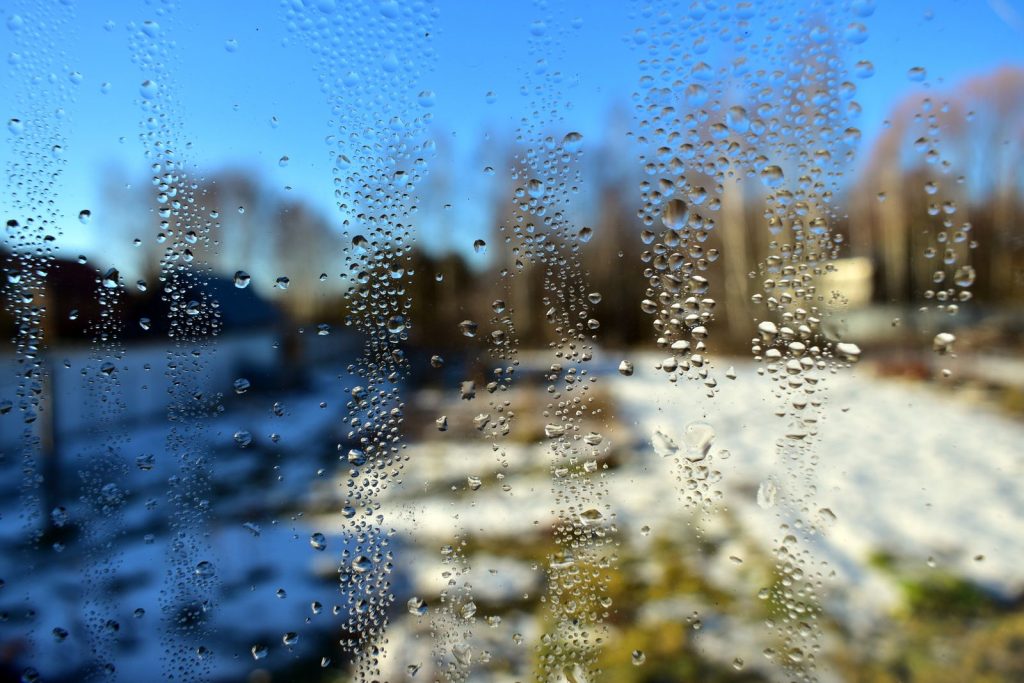
Water forms on a surface when that surface is colder than the dew point of the air touching it. A report by Pacific Northwest National Laboratory (PNNL) for the U.S. Department of Energy puts it plainly: condensation occurs when the surface temperature of a window component drops below the dew point or frost point of the adjacent air.
Your thermostat keeps the room at the same temperature all winter, but the inside face of the glass does not stay put. It gets colder every time the outdoor temperature drops. So a humidity level that is fine at 35 °F outside can leave water on the sill at 0 °F. The same PNNL report notes that in cold climates, single-glazed windows and many lower-performing double-pane windows typically get condensation and frost on the inside of the glass in winter, especially when indoor humidity is relatively high.
That is why a winter target works best as a ceiling that moves with the weather, not a fixed setting.
Find your own humidity ceiling in four steps
You need a hygrometer and a way to read surface temperature. A household infrared thermometer is the easiest option, or a digital thermometer with a probe you can tape to the glass for a few minutes.
- Pick a cold morning. Choose one of the colder mornings of the week, before the sun reaches the windows. That is when the glass is at its coldest.
- Read the room. Note the air temperature and relative humidity in the room, with the hygrometer away from the window.
- Find the coldest spot. Measure the bottom corners of the glass and the edge where the glass meets the frame, not the middle of the pane. Check the worst window in the house, often in a bedroom or on the north side, and any cold outside corner of a closet.
- Look up your ceiling. Find that surface temperature in the table below (or enter it in our dew point calculator) and take a few points off as a margin.
| Coldest surface temperature | Room at 68 °F (20 °C) | Room at 70 °F (21 °C) | Room at 72 °F (22 °C) |
|---|---|---|---|
| 60 °F (16 °C) | 76% | 71% | 66% |
| 55 °F (13 °C) | 63% | 59% | 55% |
| 50 °F (10 °C) | 53% | 49% | 46% |
| 45 °F (7 °C) | 44% | 41% | 38% |
| 40 °F (4 °C) | 36% | 34% | 31% |
| 35 °F (2 °C) | 30% | 28% | 26% |
| 30 °F (−1 °C) | 24% | 22% | 21% |
Two things stand out. First, the room temperature changes the number: the same reading means less moisture in the air of a cooler room, so its ceiling in percent is a little higher. Second, once the coldest spot is below about 40 °F, even the bottom of ENERGY STAR’s 30–40% range is too much for that spot.
Worked example
Assumed situation: a living room kept at 70 °F. On a 10 °F morning the hygrometer reads 42%, the middle of the glass reads 52 °F, and the bottom corner of the glass reads 41 °F.
- The coldest spot is the corner, at 41 °F. Ignore the 52 °F in the middle.
- Air at 70 °F reaches its dew point on a 41 °F surface at about 35% relative humidity.
- At 42%, the corners will collect water. Bringing the room down to about 30–32% leaves a margin on mornings like this one.
- On a 35 °F morning the same corner may read in the high 40s, which tolerates about 45%. The ceiling rises again as the weather warms.
max RH ≈ saturation pressure at surface temp ÷ saturation pressure at room temp
       = p_sat(41 °F) ÷ p_sat(70 °F) ≈ 0.35 → 35%
Example with assumed values. Saturation pressures from the Magnus approximation. Measure your own windows on your own cold mornings.
Technical note: why the middle of the glass misleads. In PNNL’s chamber test, a double-pane low-e window that met the 2021 energy code for cold climates (U-factor 0.30) faced 5 °F on one side and a room at 70 °F and 25% on the other. With no shade, the bottom edge of the glass was right at the dew point, with a little condensation along the sill and in the corners. Air at 70 °F and 25% has a dew point of about 32 °F. A simple estimate for the middle of the same glass, using its U-factor and a typical indoor surface coefficient (an assumed value of about 1.46 Btu/h·ft²·°F), gives roughly 57 °F. The edges and the bottom of the pane, near the frame and spacer, run far colder than the center, so measure there.
Signs the air has become too dry
Running the house too dry has its own costs. The EPA’s guide to home humidifiers says added moisture can relieve dry nose, throat, lips and skin, and can ease winter problems such as static electricity and cracks in paint and furniture. In practice, these are the signs people usually notice first:
- Static shocks from doorknobs and carpets.
- New gaps between floorboards, or wood furniture and trim that cracks or loosens.
- Paint cracking on wood.
- Air that feels dry even when the temperature is comfortable.
- Readings below 30% for days at a time.
If dry air seems to affect your health, or you have a respiratory condition, ask your doctor what is right for you. This guide does not give medical advice.
When your windows can’t take the humidity you want
Sometimes the calculation says 25% while the household wants 35%. You have two ways out: make the cold surfaces warmer, or stop extra moisture building up where it doesn’t need to.
The PNNL report comes down on the side of the windows. Its authors do not advocate lowering indoor humidity as a way to fix condensation, except where humidity is extremely high because of airtightness or HVAC problems. For cold and very cold climates they point to better windows (for example triple-pane) or an energy-efficient secondary panel, such as a storm window or interior insert, over the existing window.
- Open shades and curtains during the day. PNNL found that insulating cellular shades closed over the glass increased condensation. Its advice: open them during the day in the heating season, and wipe any water on the sill that does not dry within a few days.
- Leave a gap at the bottom. If a shade has to stay down, PNNL found that raising the bottom rail half an inch off the sill sharply reduced condensation while keeping most of the insulating effect.
- Add a storm window or interior panel on the worst windows, or upgrade them when they are due for replacement.
- Turn the humidifier down or move it. The EPA’s advice: if water condenses on windows, walls or pictures, relocate the humidifier, lower the humidistat or use the unit less.
- Deal with the moisture sources. Run bath and kitchen exhaust fans, vent the clothes dryer outdoors and avoid drying laundry on racks in cold rooms. See how to lower humidity in your house.
Walls behave like windows. The EPA notes that mold is frequently found on walls in cold corners behind furniture, where condensation forms. If outside corners or closets stay damp at a humidity your windows can handle, read our guide to condensation on walls in winter.
Setting a humidifier through the winter
If your home runs dry and you add moisture, let the weather set the number. A practical routine:
- Start at the low end, around 30%, and never above the EPA’s 50% ceiling.
- Check the coldest window on the first few cold mornings. If the corners are wet, turn the setting down a few points.
- Lower it again before a cold snap, and raise it gently when the weather turns mild.
- Keep a portable unit clean. The EPA advises emptying, drying and refilling the tank daily, cleaning it every third day and using water labeled “distilled” to reduce the minerals behind white dust.
Watch out: a humidistat set once in November and left alone is the classic cause of sweating windows in January. Water that runs onto the sill every morning is a sign the setting is too high for your windows, whatever number it shows.
Frequently asked questions
Is 25% humidity too low in winter?
It is below the 30% lower bound used by ENERGY STAR, but the PNNL report cites a recommendation to keep cold- and very-cold-climate homes near 25% in winter. Use the four steps above to see what your own windows allow. If you feel the air is too dry, warming the cold surfaces is the way to raise humidity without wet windows.
Why is my humidity high in winter when the air outside is so dry?
Cold outdoor air carries little moisture, but showers, cooking, breathing and laundry keep adding it indoors. In a tight house with little ventilation, that moisture builds up. If readings stay above 50% in winter without a humidifier, look for the sources and check that exhaust fans vent outside.
Sources
- ENERGY STAR (U.S. EPA). Dehumidifiers: 30–50% in general; 30–40% in the heating season in colder climates to prevent window condensation.
- Pilet, Mullaly, Bauer and Cort, Pacific Northwest National Laboratory, for the U.S. DOE. Evaluation of the Thermal and Moisture Performance of Insulating Shades (PNNL-33380, September 2022): how condensation forms, the 25% recommendation, the chamber test and the recommendations on shades and windows.
- U.S. EPA. Use and Care of Home Humidifiers: not above 50%, condensation, cleaning, distilled water, effects of dry air.
- U.S. EPA. Mold Course, Chapter 2: below 60%, ideally 30–50%; mold in cold corners behind furniture.
- CDC. About Mold: no higher than 50%.
- U.S. EPA. A Brief Guide to Mold, Moisture and Your Home: moisture sources and how to vent them.
Next step
Check your coldest window this week
Tool
Dew point calculator
Enter your room conditions and see how cold a surface can get before it turns wet.