
Yes, a dehumidifier helps with mold, but only on one side of the problem: it keeps the air dry enough that new mold struggles to grow. It does not kill mold, it does not remove the mold that is already there, and it cannot keep up with water that arrives as liquid, from a leak, seepage or a wall that stays cold enough to sweat. The EPA’s rule of thumb sums it up: the key to mold control is moisture control. A dehumidifier is one moisture-control tool, and it works best after the water source is fixed and the mold is cleaned up.
Mold needs water; a dehumidifier takes away one source of it
Mold spores are everywhere indoors and outdoors. What decides whether they grow on your drywall, grout or stored boxes is moisture. That moisture can come from two very different places:
- Liquid water: a roof or plumbing leak, groundwater seeping through a basement wall, a flood, a spill that soaked into carpet.
- Water vapor in the air: humid summer air, showers, cooking, laundry drying indoors. In the EPA’s words, humidity or dampness in the air can sometimes supply enough moisture for mold growth on its own.
A dehumidifier only deals with the second one. It pulls water vapor out of the air and lowers the relative humidity (RH) of the room. If humidity was the only thing feeding the mold, that can be enough to stop new growth. If the mold is fed by liquid water, the dehumidifier will run constantly and the mold will keep coming back.
How it changes the conditions in a room
A standard (compressor) dehumidifier draws room air over a cold coil. Water vapor condenses on the coil, drips into a bucket or drain hose, and the drier air passes over a warm coil and back into the room. The built-in humidistat, which ENERGY STAR says every certified model includes, lets you set a target RH; once the room reaches it, the unit cycles on and off to hold that level.
The target that matters for mold comes from the EPA: keep indoor humidity below 60%, and ideally between 30% and 50%. ENERGY STAR gives the same 30–50% range, notes that anything above it may promote mold growth, and adds that in colder climates during the heating season 30–40% helps prevent window condensation. Our guide to the ideal indoor humidity level explains how to measure it with a hygrometer before you change anything.
What a dehumidifier can and can’t do about mold
| Situation | Does a dehumidifier help? | What actually fixes it |
|---|---|---|
| Room humidity above 60% most of the time | Yes, this is its main job | Dehumidifier (or AC in summer), plus exhaust fans for bathrooms and kitchens |
| Musty basement with no visible leaks | Yes, usually a lot | Dehumidifier sized for the dampness, kept running through the humid season |
| Drying a room after a leak or spill | Yes, as part of drying | Remove the water, then fans plus a dehumidifier; dry within 24–48 hours |
| Mold already growing on walls or grout | Not by itself | Clean it off (or have it removed), then control humidity so it doesn’t return |
| Active roof or plumbing leak | No | Repair the leak |
| Water seeping through a foundation wall | Only a little | Grading, gutters, drainage; the dehumidifier handles what’s left in the air |
| Mold on a cold exterior wall or window frame in winter | Partly | Lower humidity and warmer surfaces: insulation, air movement, furniture away from the wall |
| Moldy carpet, ceiling tiles or insulation | No | The EPA says porous materials may have to be thrown away |
Two points from the table deserve emphasis. First, a dehumidifier does not kill mold. Drying out a colony may stop it from growing, but the EPA’s remediation guidance is clear that it is necessary to clean up mold contamination, not just kill it, because dead mold is still allergenic and some dead molds are potentially toxic. Second, a dehumidifier conditions the air, not the inside of a wall cavity or the underside of a soaked carpet pad; hidden wet materials can stay damp long after the room reads 45%.
Why a dry room can still have a moldy wall
Relative humidity depends on temperature. The same air that reads a comfortable 50% in the middle of the room can be close to saturated right against a cold surface, because cooler air holds less water vapor. That’s why mold so often appears in exterior corners, behind wardrobes on outside walls, and around window frames, even in homes where the hygrometer looks fine. The EPA’s advice for condensation reflects this: reduce the humidity, but also cover cold surfaces with insulation, increase air movement and raise the air temperature.
Worked example: room air vs. a cold corner
Assumed values: a bedroom at 70°F (21°C) and 50% RH, with an exterior corner whose surface is 55°F (13°C) on a cold night.
- The most water vapor air can hold (saturation vapor pressure) is about 2.5 kPa at 70°F and about 1.47 kPa at 55°F.
- The room air holds 50% of 2.5 = about 1.25 kPa of water vapor.
- When that same air touches the 55°F corner, its RH becomes 1.25 ÷ 1.47 ≈ 85%.
- Its dew point is about 50°F (10°C): if the corner gets that cold, water condenses on it.
RH at surface ≈ RH in room × p_sat(room temp) ÷ p_sat(surface temp)
               ≈ 50% × 2.5 ÷ 1.47 ≈ 85%
Lowering the room to 40% RH brings the corner down to roughly 68%, which helps. Warming the corner (moving furniture away, insulating, keeping the room heated) helps just as much. The dehumidifier alone can’t change the wall’s temperature.
Illustrative example with assumed temperatures. Saturation vapor pressures are rounded values from the standard Magnus approximation.
If this sounds like your house, our article on condensation on walls in winter goes through cold spots and thermal bridges in more detail.
Where a dehumidifier does the most good
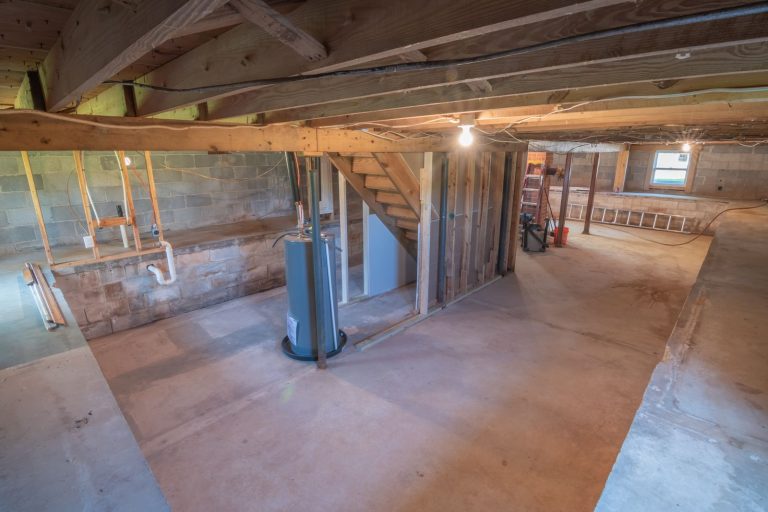
Basements and crawl spaces. Below-grade spaces are cool and pick up moisture from the ground, so humidity there often stays high all summer. ENERGY STAR describes the levels it sizes for: “slightly to moderately damp” spaces with an intermittent musty odor at 50–75% RH, “very damp” spaces with damp spots on walls and floors at 75–90%, and “wet” spaces where walls or floor sweat or seepage is present at 90–100%. The first two are exactly where a dehumidifier shines. In the third, deal with the water entry first; see finding the cause of a damp basement.
Drying out after water damage. The EPA says that if wet or damp materials are dried within 24–48 hours after a leak or spill, in most cases mold will not grow. Its guidance on drying carpet suggests removing water with a wet vacuum, then using fans to blow air over the materials and a dehumidifier to lower the humidity in the room while they dry. Professionals who dry water-damaged buildings use the same combination of large fans and dehumidifiers.
Humid seasons in tight homes. When outdoor air is humid, opening windows can add moisture rather than remove it. A dehumidifier (or air conditioning, which also removes moisture) keeps the indoor level in range. See when opening windows lowers humidity for how to tell the difference.
If you already have mold: the order of work
- Find and fix the water. Leaks, seepage, a dryer venting indoors, a bathroom fan that doesn’t reach the outside. The EPA’s cleanup steps start here.
- Decide who cleans. The EPA says that if the moldy area is less than about 10 square feet (roughly 3 ft by 3 ft), in most cases you can handle it yourself. Larger areas, or a lot of water damage, call for its remediation guidance or a professional. Our guide to cleaning small areas of mold safely covers protective equipment.
- Clean, don’t just treat. The EPA recommends scrubbing mold off hard surfaces with detergent and water and drying them completely. Absorbent materials such as ceiling tiles and carpet may have to be discarded.
- Dry everything. This is where the dehumidifier earns its place: run it with fans until materials are fully dry.
- Hold the humidity. Set the humidistat in the 30–50% range, below 60% at most, and check with a separate hygrometer for a few weeks.
- Watch the spot. If mold returns in the same place, moisture is still getting there from somewhere the dehumidifier can’t reach.
Don’t use the dehumidifier as a reason to wait. Running one next to a moldy wall can make the room feel fresher while the colony stays on the surface. Mold that keeps growing damages what it grows on, and the EPA advises cleaning it up promptly.
Signs the dehumidifier alone won’t be enough
- It runs almost nonstop and the room never gets below about 60%.
- The bucket fills far faster after rain than in dry weather (likely water entry).
- Mold comes back in the same spot after cleaning, while the rest of the room reads normal.
- There are water stains, peeling paint or soft drywall (possible leak behind the surface).
- The musty smell persists even at 45% RH (possible hidden mold).
- The affected area is larger than about 10 square feet.
A persistent odor with no visible source is covered in our guide to a musty smell in the house. And if what you’re weighing is a dehumidifier versus a filter, note that the EPA says air cleaners will not resolve a mold and moisture problem either; our dehumidifier vs. air purifier comparison explains why.
Getting the size and setting right
An undersized unit in a damp basement will run all day without reaching the target, which is when people conclude that dehumidifiers “don’t work.” ENERGY STAR recommends 20–30 pints per day for a slightly to moderately damp space under 2,000 sq ft, 25–40 for a very damp one and 30–50 for a wet one. Our article on what size dehumidifier you need walks through that chart, and where to place it covers airflow, closed doors and drainage.
Keep the unit itself clean, too: empty the bucket regularly or use a drain hose, and clean the filter as the manual describes, so the dehumidifier doesn’t become a damp spot of its own.
About health: this article is about controlling moisture, not about symptoms. If you’re worried about how mold may be affecting you or someone in your home, talk to a doctor and see the EPA’s and CDC’s information on mold and health. Our summary of what health agencies say about household mold links to them.
Sources
- U.S. EPA. A Brief Guide to Mold, Moisture, and Your Home: moisture control, humidity below 60% (ideally 30–50%), drying within 24–48 hours, condensation on cold surfaces.
- U.S. EPA. Mold Cleanup in Your Home and What are the basic mold cleanup steps?: the 10 sq ft threshold, detergent and water, porous materials.
- U.S. EPA. Mold Remediation in Schools and Commercial Buildings, Chapter 3: “clean up mold contamination, not just kill the mold”; dead mold is still allergenic.
- U.S. EPA. Mold Course, Chapter 2 and Chapter 4: humidity as a moisture source, drying with fans and dehumidifiers.
- ENERGY STAR. Dehumidifiers: built-in humidistat, 30–50% RH, damp-space categories and sizing.
- U.S. EPA. Guide to Air Cleaners in the Home: air cleaners will not resolve a mold and moisture problem.
Next step
Keeping mold from coming back
Dehumidifiers
Where to place it and what to set
Placement, doors and the humidity setting that works.