Quick answer
Limescale is calcium carbonate left behind by hard water, and a mild acid such as white vinegar dissolves it. For a plastic shower head, K-State Research and Extension suggests soaking it in equal parts white vinegar and hot water for about an hour; for a metal one, it suggests boiling it for 15 minutes in ½ cup of vinegar per quart of water. If you can’t remove the head, tie a vinegar-filled bag around it. Then scrub the nozzles, rinse and repeat every few weeks or months depending on how hard your water is.
What limescale is and why shower heads clog
Hard water carries dissolved calcium and magnesium. The U.S. Geological Survey explains that when hard water is heated, solid deposits of calcium carbonate can form. A shower head gets this twice over: hot water passes through it every day, and after each shower the drops left in the nozzles evaporate and leave their minerals behind.
Over weeks, those white or chalky deposits narrow the nozzle openings. The result is a weaker, uneven spray, jets that shoot sideways and nozzles that stop working. Limescale is not a health hazard; the USGS describes hard water as not dangerous but unsightly, and notes that scale also reduces the efficiency of water heaters and can clog pipes.
How hard is your water?
How often you need to descale depends on your water. The USGS uses this general classification, measured as milligrams of calcium carbonate per liter:
| Hardness (mg/L as calcium carbonate) | Classification | What to expect on a shower head |
|---|---|---|
| 0–60 | Soft | Little or no scale |
| 61–120 | Moderately hard | Slow buildup; occasional descaling |
| 121–180 | Hard | Visible scale within weeks to months |
| Over 180 | Very hard | Frequent clogging; regular descaling needed |
To find your number, check your utility’s annual drinking water quality report. The EPA requires community water systems to send this Consumer Confidence Report to customers each year by July 1; if yours doesn’t list hardness, call the utility. On a private well, a water test will tell you.
Technical note: hardness is often quoted in grains per gallon (gpg) instead of mg/L. One grain per gallon equals about 17.1 mg/L, so 7 gpg is roughly 120 mg/L, the line between “moderately hard” and “hard” in the USGS classification.
Method 1: soak a removable shower head
This is the most thorough method. K-State Research and Extension gives separate instructions for plastic and metal heads:
- Remove the head. Unscrew it by hand; if it’s tight, wrap the connection in a cloth before using pliers so you don’t scratch the finish. Keep the rubber washer.
- Plastic head: mix 1 pint of white vinegar with 1 pint of hot water, submerge the head completely and soak for about one hour.
- Metal head: mix ½ cup of white vinegar with 1 quart of water, submerge the head completely and boil for 15 minutes. Use a pot you don’t mind cleaning afterward, and let it cool before handling.
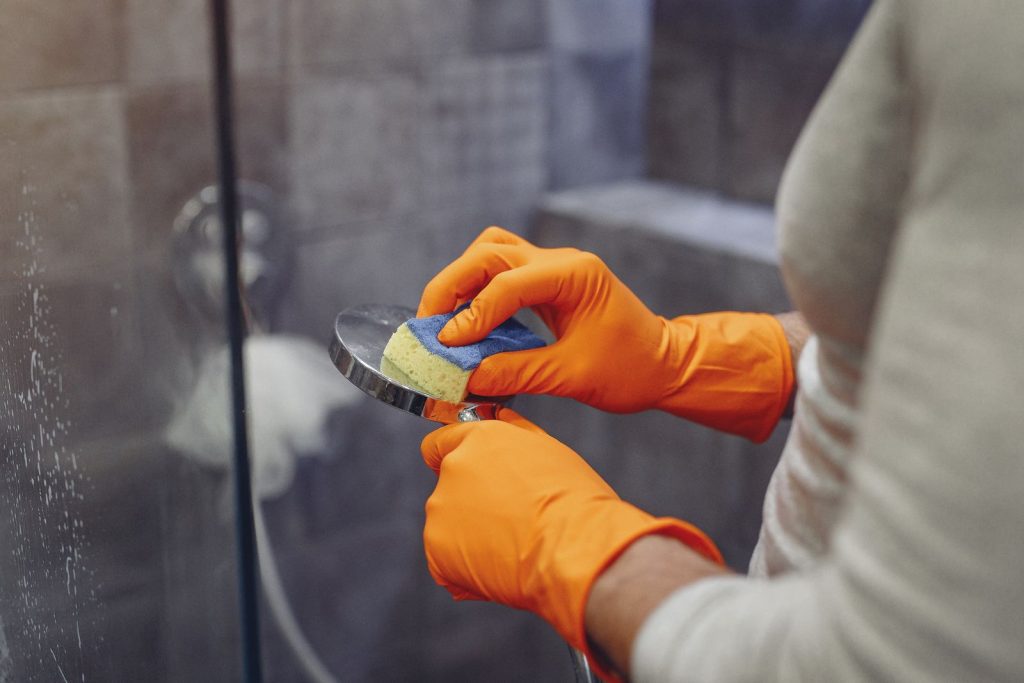
- Scrub. Use an old toothbrush on the face. Many heads have flexible rubber nozzles: rub them with your thumb to pop out loosened flakes.
- Rinse and reinstall. Flush with clean water, refit the washer and screw the head back on. Run the shower for a minute to clear any loose bits.
Watch out: don’t boil a plastic head, and check the manufacturer’s care instructions for heads with special finishes (brass, brushed nickel, matte black, gold tones), which acids can dull or mark. When in doubt, use a shorter soak and test on a hidden spot first.
Method 2: descale a fixed shower head in place
If the head can’t come off, bring the vinegar to it. K-State’s advice for faucets is that hard lime deposits soften for easy removal if you cover them with vinegar-soaked paper towels for about an hour. The same idea works on a shower head:
- Fill a sturdy plastic bag with enough white vinegar to cover the face of the head.
- Slip it over the head and secure it with a rubber band or twist tie.
- Leave it for about an hour, then remove the bag and scrub the nozzles.
- Run hot water through the head for a minute to flush dissolved scale.
Worked example: how much vinegar?
Assumed situation: a plastic hand shower that needs about 1 quart of liquid to be fully covered in a bowl.
- K-State’s plastic-head ratio is 1 pint vinegar to 1 pint hot water, or 1:1.
- 1 quart = 2 pints, so you need 1 pint of vinegar and 1 pint of hot water.
- For a metal head in a pot that needs 2 quarts to cover it, the metal ratio (½ cup per quart) gives 1 cup of vinegar in 2 quarts of water.
Illustrative example; volumes are assumed. Ratios from K-State Research and Extension.
Safety: what not to mix
Vinegar is mild, but bathroom cleaners are not always compatible. K-State warns never to mix bleach with vinegar, toilet bowl cleaner or ammonia, because the combination produces a toxic gas. The University of Arkansas Cooperative Extension Service gives the same warning about bleach and ammonia. If you have already used a bleach-based cleaner on the shower, rinse everything thoroughly before bringing in vinegar, and keep the bathroom ventilated.
Commercial descalers work too; follow the label, wear gloves and never combine them with other products.
How to stop limescale coming back
Prevention checklist
- Wipe the face after showering. Rubbing the nozzles for a few seconds while they’re wet removes minerals before they harden.
- Descale on a schedule. A short soak every month or two is easier than a long battle with a clogged head.
- Choose rubber nozzles. Flexible nozzles let you flick out scale by hand.
- Check the inlet screen. Many heads have a small filter screen behind the washer that collects scale and grit.
- Treat the water if scale is everywhere. If kettles, faucets and the water heater all suffer, a whole-house water softener is the structural fix; weigh cost and maintenance first.
If the spray stays weak after descaling, the cause may be elsewhere: a flow restrictor, a clogged inlet screen, low water pressure in the house, or a failing cartridge in the shower valve.
Frequently asked questions
How long should I soak a shower head in vinegar?
K-State suggests about one hour for a plastic head in equal parts vinegar and hot water. Heavily scaled heads may need a second round. Metal heads can be boiled for 15 minutes in a weaker solution.
Is limescale in the shower dangerous?
No. The USGS describes hard water deposits as unsightly and costly for appliances, not dangerous. The problem is clogged nozzles and weaker spray.
Can I use lemon juice instead of vinegar?
The University of Arkansas extension lists acids such as vinegar and lemon juice as alternatives for breaking down mineral deposits and hard water stains. Vinegar is cheaper for a full soak.
How often should I descale?
It depends on your water hardness and use. With very hard water, monthly may be needed; with moderately hard water, a few times a year is often enough. Watch the spray pattern: when jets go crooked, it’s time.
Sources
- K-State Research and Extension, Johnson County. Homemade Cleaners (PDF): shower head and faucet descaling, bleach mixing warning.
- U.S. Geological Survey. Hardness of Water: classification and scale.
- U.S. EPA. Consumer Confidence Report: information for consumers.
- University of Arkansas Cooperative Extension Service. Clean and Green Homemade Cleaners: acids for mineral deposits, bleach and ammonia.
Next step