Quick answer
Hard water shows up as white scale on faucets and shower heads, spots or film on glasses, soap that doesn’t lather well and a slimy feeling on your hands after washing. To know how hard it really is, look up your utility’s annual water quality report or test a sample. The U.S. Geological Survey classifies water with 0–60 mg/L of calcium carbonate as soft, 61–120 as moderately hard, 121–180 as hard and over 180 as very hard. Hard water is a nuisance for pipes, appliances and cleaning, not a health hazard.
What hard water is
The USGS defines water hardness, in scientific terms, as the amount of dissolved calcium and magnesium in water. Groundwater picks up these minerals as it moves through soil and rock, so hardness depends on local geology and on your water source. The USGS notes that hardness varies across the United States and that systems using groundwater are particularly concerned with it.
Hardness isn’t a contaminant problem. The USGS points out that the World Health Organization considers drinking water a possible contributor of calcium and magnesium in the diet. The downsides are practical: scale, soap scum and extra cleaning.
Signs of hard water around the house
Hard water checklist
- Film on your hands after washing. The USGS explains that soap reacts with calcium to form soap scum, which can leave a residue on skin.
- More soap and detergent needed. With hard water, more soap or detergent is needed to get hands, hair or laundry clean (USGS).
- Spots and film on glasses after the dishwasher. The USGS names hard water as one of the most common causes of cloudy dishes and glassware.
- White crust on faucets, shower heads and tile, left behind when drops evaporate.
- Scale in kettles, coffee makers and water heaters. The USGS explains that heating hard water forms calcium carbonate deposits that can shorten equipment life, raise heating costs and clog pipes.
- Weaker shower spray as nozzles fill with scale.
Signs are a hint, not a measurement. Very soft water can also leave spots if a dishwasher’s rinse cycle is off, and some faucet deposits come from other minerals. Put a number on it before spending money.
How hard is your water? The numbers
| USGS classification | mg/L as calcium carbonate | Approx. grains per gallon |
|---|---|---|
| Soft | 0–60 | 0–3.5 |
| Moderately hard | 61–120 | 3.6–7.0 |
| Hard | 121–180 | 7.1–10.5 |
| Very hard | More than 180 | More than 10.5 |
Units: utilities and labs usually report hardness in mg/L (milligrams per liter, the same as parts per million) “as calcium carbonate”. Water softener makers and test kits often use grains per gallon (gpg). One grain per gallon is about 17.1 mg/L, so divide mg/L by 17.1 to get gpg.
Worked example: reading your report
Assumed value: your utility’s report lists total hardness as 150 mg/L as CaCO₃.
- USGS class: 121–180 mg/L → “hard”.
- In grains per gallon: 150 ÷ 17.1 ≈ 8.8 gpg.
- What to expect: visible scale on fixtures within weeks to months and regular descaling of kettles and shower heads.
Illustrative example; 150 mg/L is an assumed value. The last step is general guidance, not measured data.
Where to find your hardness
- Your utility’s water quality report. The EPA requires community water systems to send customers a Consumer Confidence Report each year by July 1. If you didn’t get one, call your supplier or use the EPA’s CCR search tool. Hardness isn’t always listed, since it’s not a health standard; if it’s missing, ask the utility.
- A home test strip. Dip strips give a rough range in minutes. Good enough to tell soft from very hard.
- A certified lab. On a private well, a lab test gives an exact figure and can check other parameters at the same time.
Watch out: a free “water test” offered by someone selling treatment equipment isn’t a neutral measurement. Use your utility’s report or an independent certified laboratory before deciding on any purchase.
What the numbers mean in practice
| Your water | Typical impact | Reasonable response |
|---|---|---|
| Soft | Little or no scale | Nothing needed |
| Moderately hard | Some spotting and slow scale | Wipe fixtures, descale occasionally |
| Hard | Regular scale on fixtures and kettles | Routine descaling, dishwasher rinse aid, check water heater |
| Very hard | Heavy scale, clogged aerators and heads | Consider whole-house treatment after weighing costs |
For most homes, regular cleaning handles hard water fine. Descaling a shower head with vinegar, for example, takes an hour of soaking. Whole-house water softening is a bigger decision with its own costs and upkeep.
Cleaning hard water deposits
Hard water deposits are alkaline mineral scale, so mild acids dissolve them. The University of Arkansas Cooperative Extension Service lists acids such as vinegar and lemon juice for breaking down mineral deposits and hard water stains. K-State Research and Extension gives these practical methods:
- Faucets: cover hard lime deposits with vinegar-soaked paper towels for about one hour, then clean. The deposits soften for easy removal.
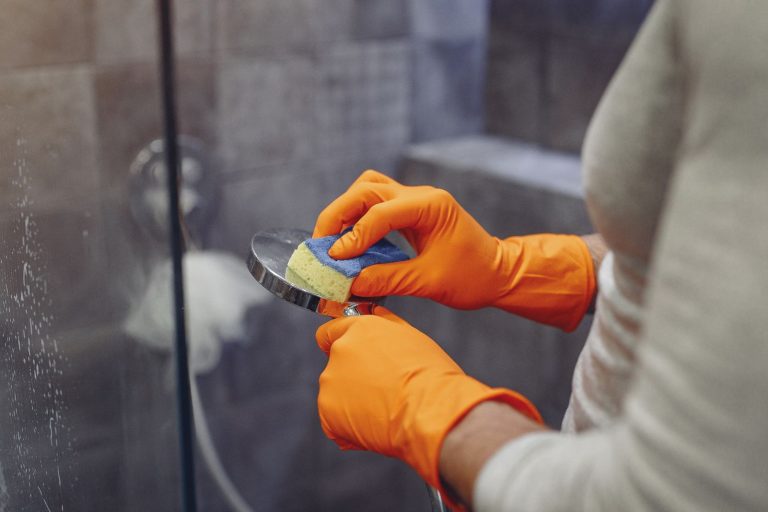
- Shower heads: soak a plastic head for about an hour in equal parts white vinegar and hot water; a metal head can be boiled for 15 minutes in ½ cup vinegar per quart of water.
- Glass and windows: use undiluted vinegar on stubborn hard water spots and streaks.
- Ceramic tile: K-State notes that washing tile with soap doesn’t work well in hard water areas because it leaves an insoluble film; a vinegar-and-water solution avoids that.
Two cautions. K-State warns never to mix bleach with vinegar, toilet bowl cleaner or ammonia, because the combination produces a toxic gas. And check the manufacturer’s care instructions before using acids on natural stone or special finishes, since acids can etch or dull some surfaces. Rinse surfaces with clean water afterward and dry them, so new drops don’t leave fresh spots.
Frequently asked questions
Is hard water safe to drink?
The USGS describes hard water deposits as not dangerous, and notes the WHO view that drinking water can contribute calcium and magnesium to the diet. For any health question, see your health provider.
How can I tell if I have hard water without a test?
Look for white scale on faucets, spots on glasses, soap that doesn’t lather and a film on your skin after washing. These are strong hints, but a test or your utility report gives the real number.
What is considered very hard water?
The USGS classifies more than 180 mg/L as calcium carbonate as very hard, which is about 10.5 grains per gallon.
Does hard water damage appliances?
The USGS says scale from heated hard water can reduce equipment life, raise water heating costs, lower the efficiency of electric water heaters and clog pipes.
Sources
- U.S. Geological Survey. Hardness of Water: definition, signs, classification, scale, WHO note.
- U.S. EPA. Consumer Confidence Report: information for consumers.
- U.S. EPA. Consumer Confidence Reports.
- K-State Research and Extension, Johnson County. Homemade Cleaners (PDF).
- University of Arkansas Cooperative Extension Service. Clean and Green Homemade Cleaners.
Next step