
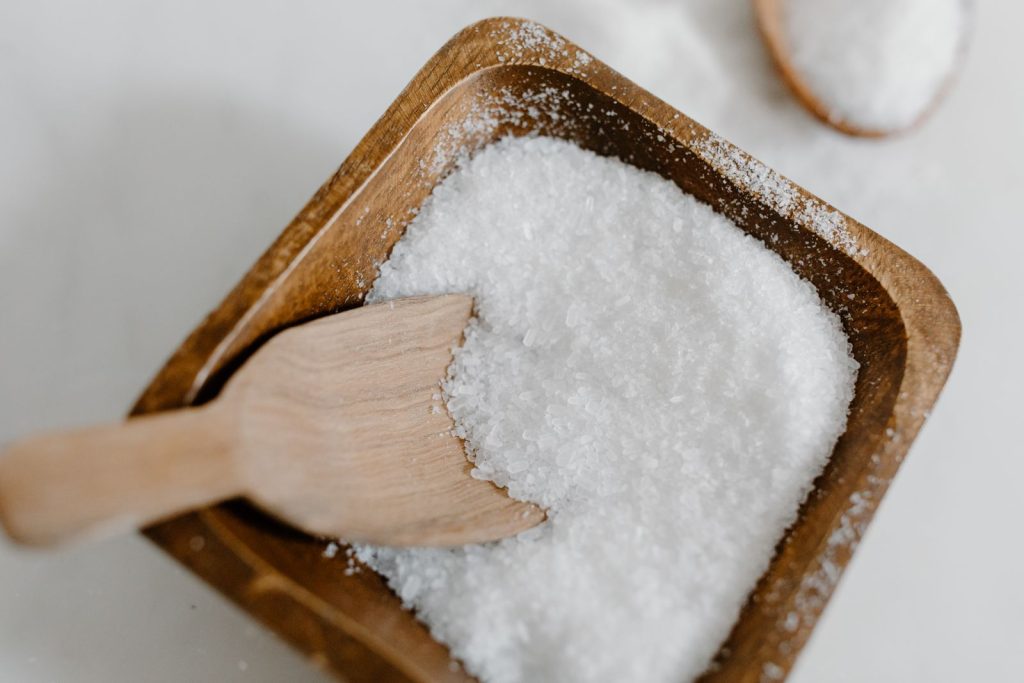
Quick answer
Use the type of water softener salt your manufacturer specifies: University of Nebraska–Lincoln Extension notes that most softeners are designed for compressed evaporated salt (pellets, nuggets or beads), that block salt belongs only in units built for it, and that rock salt is an option only if the manufacturer suggests it. How much salt you go through depends on household size, water use, hardness and the softener’s capacity and settings, so there’s no universal number. Check the brine tank regularly, keep it topped up as the manual says, and make sure the softener is set to your actual water hardness; Minnesota health officials warn that a setting that’s too high costs more and wastes water.
What the salt actually does
The salt never touches your tap water directly. A softener holds a bed of resin beads that trap calcium and magnesium, the minerals that make water hard, and release sodium (or potassium) in their place. When the beads are full, the unit regenerates: it flushes them with a strong brine made in the brine tank from the salt you add. The Minnesota Department of Health describes the waste from that flush as a chloride solution that goes down the drain and ultimately into the environment.
So the salt is a consumable for regeneration. If the brine tank runs empty, or the salt can’t dissolve, the resin stops being recharged and hard water flows straight through to your pipes and water heater. UNL Extension puts it simply: the softener must be kept regenerated to avoid hard water flowing into pipes and appliances.
Types of water softener salt
UNL Extension stresses that softeners are designed to use specific types of salt, so the manual is your first reference. This is how the common options compare.
| Type | What it is | When to use it |
|---|---|---|
| Compressed evaporated salt (pellets, nuggets, beads) | Salt that has gone through evaporation and compression into small, sized particles | What the majority of softeners are designed for |
| Iron-control formulas | Compressed salt with food-grade additives such as citric acid to manage iron (rust) | When your manual allows it and your water carries iron |
| Block salt | High-grade evaporated salt pressed into blocks, without additives | Only in units specifically designed for blocks; livestock blocks may contain additives that don’t belong in a softener |
| Rock salt | Mined salt that may carry soluble or insoluble impurities | Only if the manufacturer suggests it, and only rock salt averaging less than 1% impurities |
| Potassium chloride | A sodium-free alternative for regeneration | When sodium needs to be limited for health or environmental reasons; costs more and is less efficient |
Why the fuss about purity? UNL explains that if the impurities in rock salt are calcium or magnesium salts, they can significantly reduce the effectiveness of regeneration and plug valves. You’ll also see bags labeled “solar salt,” made by evaporating brine in the open air. Treat it like any other option: use it only if it’s on your manufacturer’s list.
Don’t improvise: table salt, ice melt and livestock blocks are not softener salt. Use products sold for water softeners, and read the manufacturer’s instructions before adding any chemicals or resin cleaners to the unit, as the Minnesota Department of Health advises.
Sodium chloride or potassium chloride?
Standard softener salt is sodium chloride, and it adds sodium to your water. UNL Extension puts the rate at about 8 mg/L of sodium for each grain per gallon (gpg) of hardness removed, so water that started at 10 gpg ends up with about 80 mg/L. The Minnesota Department of Health suggests two ways to cut the sodium you drink: keep an unsoftened tap for cooking and drinking, or regenerate with potassium chloride, which it says is available at most stores that sell softener salt.
| Sodium chloride | Potassium chloride | |
|---|---|---|
| Adds sodium to softened water | Yes, about 8 mg/L per gpg removed | No sodium from regeneration |
| Cost and availability | Cheaper, widely sold | Can be more costly and harder to obtain (UNL) |
| Efficiency | Reference | Adheres more strongly to the resin, which can lower exchange efficiency and require more product (UNL) |
| Before switching | — | UNL suggests consulting a water treatment professional |
If you or someone at home has a history of high blood pressure, the Minnesota Department of Health says to consult a doctor about drinking softened water. This guide doesn’t give medical advice; the bypass tap and potassium chloride are simply the two options health agencies mention.
How much salt to add and how often
There’s no single answer, and anyone who gives you one without asking about your water is guessing. UNL Extension lists the factors: the number of people in the household, daily water use, the softener’s capacity and the water hardness. Add the unit’s settings to that list. Your manual tells you how much salt goes in per regeneration and how full to keep the brine tank; the hardness setting and water use decide how often it regenerates.
Worked example: estimating your monthly salt use
Assumed values: water hardness 15 gpg (about 257 mg/L); the household uses 240 gallons of softened water a day; the softener regenerates after removing 24,000 grains; the manual says each regeneration uses 8 lb of salt.
- Hardness removed per day: 15 gpg × 240 gallons = 3,600 grains.
- Days between regenerations: 24,000 ÷ 3,600 ≈ 6.7, so roughly once a week.
- Regenerations per month: 30 ÷ 6.7 ≈ 4.5.
- Salt per month: 4.5 × 8 lb ≈ 36 lb.
- If the hardness setting were wrongly entered as 25 gpg, the unit would count 6,000 grains a day, regenerate every 4 days and use about 60 lb a month for the same water.
Illustrative example with assumed values. Use your own hardness, water use and the figures in your softener’s manual.
Settings matter more than most people think. In a rebate program in Marshall, Minnesota, reported by the Minnesota Pollution Control Agency (MPCA), households that adjusted or replaced old softeners cut salt use by up to 86%, in some cases from about four bags a month to two bags a year. That’s an extreme case, but it shows how much salt a badly set or outdated unit can waste. Find your hardness in your utility’s water quality report or with our water hardness calculator.
How to add salt and look after the brine tank
- Check the manual for the salt type and the fill level it recommends.
- Look inside before you pour. Push gently on the salt with a broom handle. If it sounds hollow or feels like a hard crust over empty space, you have a salt bridge (see below).
- Add salt to the level in the manual, breaking up any clumps from the bag.
- Stick to one product. If you switch type, let the old salt run low first so you can see how the new one behaves.
- Inspect and clean the tank periodically. UNL Extension says how often depends on the type and amount of salt and on your water; inspect for scale build-up, and clean and inspect the brine valve and float assembly, if your unit has one, at least once a year.
Signs something is wrong
- Salt level never drops, but scale and spots come back: likely a salt bridge, a hard crust that keeps the salt above the water so no brine forms.
- Sludge on the bottom of the tank: undissolved residue, often from lower-purity salt; the tank needs cleaning.
- The unit seems to use more salt than expected, or water isn’t soft: UNL advises having a service provider check the settings.
- Iron or cloudy water: the Minnesota Department of Health notes that iron or manganese exposed to air or chlorine can foul the resin, and mud and clay can clog it; backwashing or a pre-filter may help.
How to use less salt
Less salt means lower running costs and less chloride in rivers and lakes. The Minnesota Department of Health notes that it takes only one teaspoon of sodium chloride to permanently pollute five gallons of water, and that wastewater treatment plants and septic systems don’t remove it.
- Set the softener to your real hardness. MDH says a setting that’s too high costs more to operate and wastes water.
- Check whether your utility already softens. According to MDH, utility-softened water doesn’t need more softening and extra softening may cause corrosion.
- Soften only what you need. MDH says toilets, hose bibs, basement sinks and other cold water taps typically don’t need softened water; some homes soften only the hot water.
- Prefer demand-based regeneration. UNL notes that demand-initiated units may use less salt and water overall because they regenerate only when necessary. With a timer unit, MPCA suggests lengthening the time between regenerations if your water use has dropped.
- Consider an upgrade if your softener is old and timer-based; MPCA recommends high-efficiency softeners.
Frequently asked questions
Can I use rock salt in my water softener?
Only if your manufacturer suggests it. UNL Extension says rock salt may carry impurities that reduce regeneration and plug valves, and recommends only rock salt averaging less than 1% impurities.
How often should I add salt?
Whenever the level drops below what the manual recommends. A simple habit is to look in the tank on a fixed day each month at first, then adjust once you know how fast your unit uses salt; very hard water and heavy use empty it faster. The worked example above shows how to estimate your own rate.
Is potassium chloride better than salt?
It avoids adding sodium, which matters for some households, but UNL notes it can cost more, be harder to find and be less efficient. Ask a water treatment professional whether your unit needs a setting change for it.
Why is my brine tank full of water?
Some designs keep water in the tank permanently; others refill only before regeneration. Standing water well above the normal level, or a tank that never empties, can point to a blocked valve or float, which UNL recommends inspecting at least once a year. Check the manual or call a service provider.
Sources
- University of Nebraska–Lincoln Extension. G1491 Drinking Water Treatment: Water Softening (Ion Exchange) (types of salt, maintenance, sodium).
- Minnesota Department of Health. Home Water Softening: Frequently Asked Questions.
- Minnesota Pollution Control Agency. MPCA’s chloride reduction grants cut salt use (Marshall rebate program).
- U.S. Geological Survey. Hardness of Water.
Next step
To keep your softener working well
Calculator
Water hardness calculator
Convert your utility’s figure to grains per gallon for the softener setting.